Which AI Accounting Software Startups Have Raised Big Rounds Since 2024?
Five US AI accounting software startups raised $391 million in rounds since October 2025, and France’s Pennylane added €175 million.
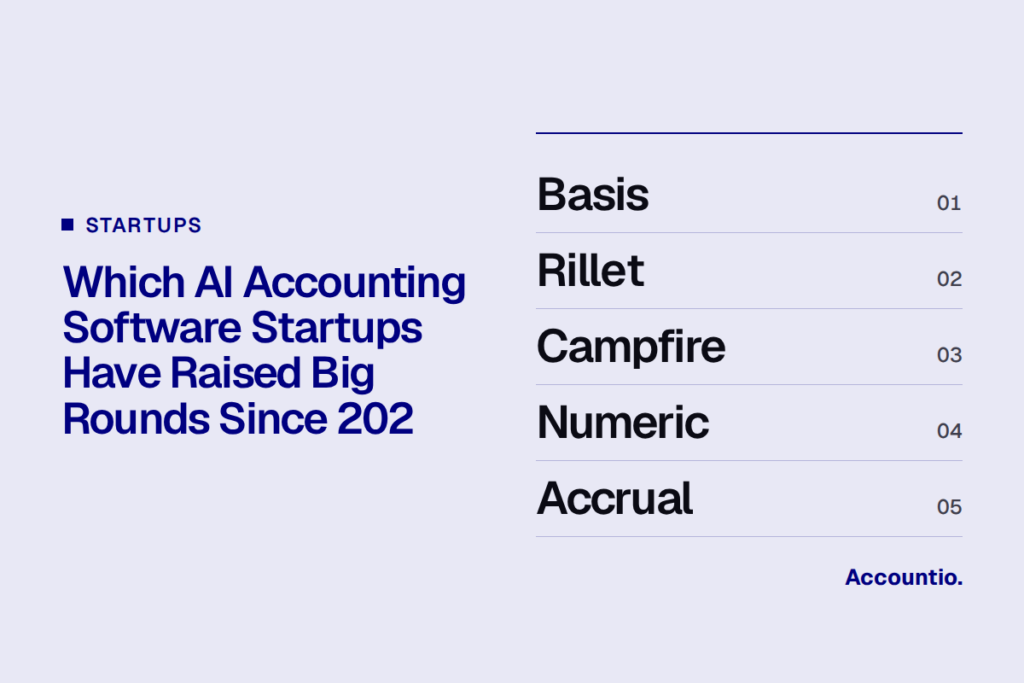
AI accounting software startups Basis, Rillet, Campfire, Numeric and Accrual have raised $391 million in five rounds announced since October 2025, while France’s Pennylane raised €175 million in January 2026.
The money is going to products that do the ledger work itself: closing the books, reconciling accounts and preparing tax returns, with a person reviewing the result. For firm partners and finance chiefs, the question is which of these vendors will still be standing when contracts come up for renewal.
The valuations show how fast the category has moved. Basis reached $1.15 billion in February 2026 and Rillet reached $1 billion in August 2026, both within about two years of launch.
This roundup covers the largest disclosed rounds, with date, lead investor and what each product automates. Figures come from the companies’ own announcements. Where a company has not disclosed a number, it is left out.
AI accounting software startups in the US
Basis, based in New York, announced a $100 million Series B on February 24, 2026, at a valuation of $1.15 billion. Accel led the round and GV, formerly Google Ventures, took part. Total funding stands at $138 million. Our earlier report on the round covers the investor list.
Basis sells agents to accounting firms across tax, client accounting services and audit. Its announcement describes agents that complete a partnership tax workbook end to end, create complex journal entries, debug reconciliations and draft technical accounting memos. Founders Matthew Harpe and Mitchell Troyanovsky wrote: “We’re deploying real agents to do real work in the real economy.”
Rillet has raised three rounds in 14 months. Sequoia led a $25 million Series A in 2025. Andreessen Horowitz and ICONIQ co-led a $70 million Series B announced on August 6, 2025, which also included Sequoia and Oak HC/FT.
The $100 million Series C came in August 2026 at a $1 billion valuation, led by ICONIQ. Sequoia and Andreessen Horowitz continued as investors, joined by Sequoia Global Equities, Bain Capital Ventures, Oak HC/FT, Battery Ventures, FirstMark, Creandum and Scale Venture Partners. Total funding is above $200 million.
Rillet is an ERP rather than an add-on. It automates the general ledger, accounts receivable and payable, bank reconciliation and close management. It has more than 600 customers, against 100 at the end of the prior year, and new annual recurring revenue doubled in the last quarter.
“We weren’t planning to raise again this soon.”
Nicolas Kopp, CEO and Founder, Rillet
Campfire, a San Francisco ERP rival, announced a $65 million Series B on October 15, 2025, co-led by Accel and Ribbit. Foundation Capital, Y Combinator and finance executives from Ramp, Snowflake, Clay, Supabase and Checkr also invested. The round took total funding to $100 million raised in 12 weeks.
Campfire’s product is a cloud ERP built around its Large Accounting Model, which it says reaches 95% accuracy on tasks such as reconciliations and variance analysis. PostHog, Decagon and Replit run their finance operations on it. Our coverage of the Campfire round has more detail, and the Campfire vs Rillet comparison sets the two ERPs side by side.
Close and tax automation rounds
Numeric announced a $51 million Series B on November 19, 2025, led by IVP. Menlo Ventures, Founders Fund, Fifth Down, Alkeon, 8VC, Socii Capital and Access Industries also participated.
Numeric started with month-end close management and is widening into a financial data platform. It launched a Cash Management product alongside the round, with a cash matching rate above 90% and an AI rule builder. Customers named in the announcement include Wealthfront, Brex, OpenAI and Plaid.
Accrual, a San Francisco startup, emerged from stealth on February 5, 2026 with $75 million. General Catalyst led, with Pruven Capital, Edward Jones Ventures and industry executives participating.
Accrual targets preparation and review work at accounting firms, starting with individual tax returns. Its software reads K-1s, 1099s, spreadsheets, emails and long statements, and feeds existing tax engines rather than replacing them. H&R Block, Armanino and Creative Planning are early customers.
European AI accounting software startups
Pennylane, the Paris accounting and finance platform, raised €175 million in January 2026, according to its investor page. TCV led, with Blackstone Growth joining existing shareholders Sequoia Capital, DST Global, CapitalG and Meritech Capital.
It had raised €75 million in April 2025, a round Pennylane tied to French e-invoicing. The latest money goes to AI tools for accountants, e-invoicing infrastructure and entry into more European markets. The company serves about 6,000 accounting firms and 800,000 small and mid-sized businesses, and half of its 1,000 employees work in research and development.
In Berlin, Integral announced a $20.6 million Series A in September 2026, led jointly by Mosaic Ventures and Reid Hoffman. Cherry Ventures, General Catalyst and Puzzle Ventures, existing backers, also took part. Integral’s agents handle invoice reconciliation, general ledger postings, payroll execution and statutory tax return preparation, and its licensed practice, Integral Tax, serves corporate clients in Germany.
UK buyers and AI accounting software startups
None of the larger rounds in this roundup went to a UK-headquartered company. UK firms are still customers: the Basis and Accrual lists include US firms, but Rillet, Campfire and Numeric sell cloud products that connect to existing ledgers and banks, and Pennylane’s growth is concentrated in France and the markets it is entering.
For a practice weighing a purchase, the useful comparison is scope. Basis and Accrual sell to accountants and automate the firm’s own production work. Rillet and Campfire replace the ledger of the client company. Numeric sits on top of the ledger the finance team already runs. Our guide to month-end close software by company size shows where each type of tool fits.
What the rounds say about AI accounting software startups
Pace is the first pattern. Campfire raised $100 million in 12 weeks. Rillet closed three rounds in 14 months. Pennylane’s chief executive Arthur Waller has said the company had no immediate need for funding and took the capital at low dilution.
Concentration is the second. Accel backed both Basis and Campfire. Sequoia backed Rillet and Pennylane. General Catalyst backed Accrual and has also invested in Integral.
Evidence is the third gap. Customer counts and accuracy figures in these announcements come from the vendors. None of the five US companies has published audited revenue, and the funding pages carry no independent benchmark of how often reviewers have to redo agent work.
The older pattern of buying in the category was a single close or consolidation tool. These rounds finance companies that want the whole ledger or the whole engagement, which raises the cost of switching later.
What comes next for the funded field
Rillet said in its Series C announcement that it was not planning to raise again so soon, and its stated priority is expanding the AI agents inside its ledger. Pennylane is spending on German localisation and e-invoicing. Numeric is moving from close management toward a data platform for enterprise finance teams.
Campfire, whose October 2025 Series B is the oldest of the US rounds listed here, has not disclosed a round since.
Accountio.
The go-to weekly newsletter for accounting professionals. Trusted by 10,000+ industry leaders to deliver the tech trends and insights that matter most. Join them today.