
Month End Close Software: BlackLine, FloQast, Numeric Compared
BlackLine has 4,260 customers; FloQast, Trintech, Numeric and Ledge target smaller teams with AI-built reconciliations and flux analysis.
BlackLine, the only publicly listed vendor among the five main names in month end close software, ended June with 4,260 customers and $187.8 million in second-quarter revenue, while four rivals pitch AI-built reconciliations at smaller finance teams.
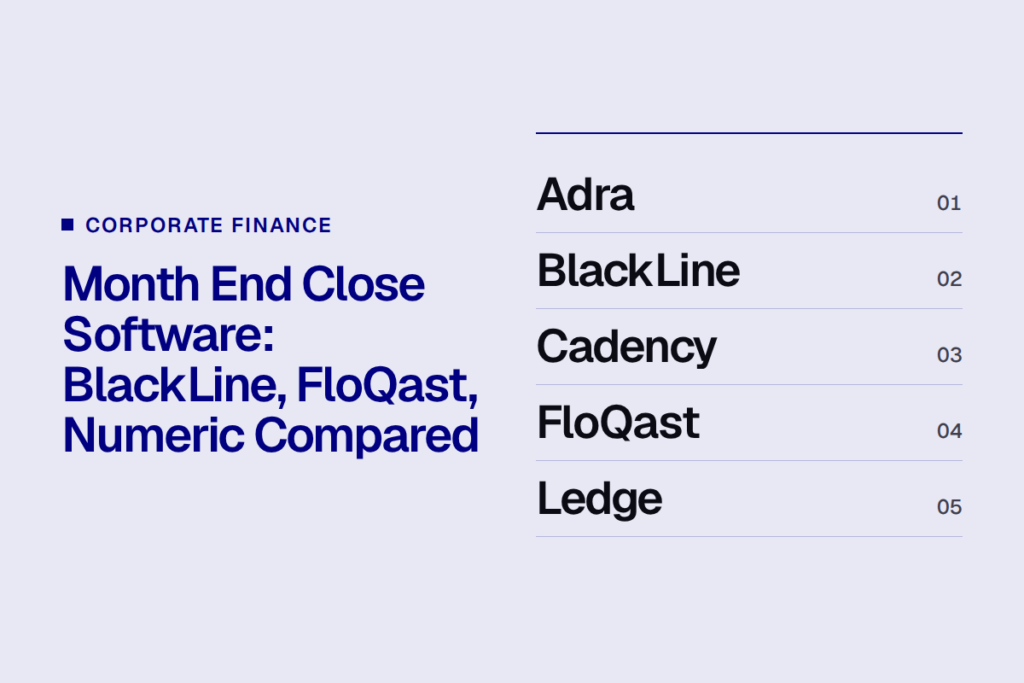
The five products are BlackLine, FloQast, Trintech, Numeric and Ledge. They overlap on close checklists, account reconciliation and variance work, but they differ sharply on who they are built for, which ERPs they connect to and how much of their business sits outside the United States.
For a finance director in London, Frankfurt or Chicago, the choice decides how much of the close is prepared by software and how much by staff. BlackLine’s reconciliation agent reached general availability on July 27, 2026, and every rival now sells a version of the same idea. Our ranking of the best month-end close software covers the wider field.
Pricing is the gap in the comparison. None of the five publishes a price list on the pages reviewed for this article. FloQast, Numeric and Ledge direct buyers to a demo, and figures quoted by third-party marketplaces could not be confirmed with the vendors, so none appears here.
Month end close software: how the five compare
The table of differences is short. BlackLine and Trintech are the established enterprise names, FloQast sits across mid-market and enterprise, and Numeric and Ledge are the younger vendors built around AI from the start.
- BlackLine: 4,260 customers at June 30, 2026, aimed at large and global finance teams, with reconciliation, task management and intercompany tools on one platform.
- FloQast: more than 3,500 companies, with close checklists, reconciliations and AI variance analysis.
- Trintech: Cadency for close task management and Adra for transaction matching and reconciliation, split into large-enterprise and mid-enterprise offerings.
- Numeric: close checklist, reconciliation and flux analysis, with a customer list weighted to US technology and fintech companies.
- Ledge: AI agents that prepare reconciliations, working papers and journal entries, with customers in the US and Europe.
The sections below take the vendors one at a time, starting with the largest.
BlackLine sets the scale for enterprise close
BlackLine reported second-quarter revenue of $187.8 million, up 9.2% on the same quarter of 2025. Full-year 2025 revenue was $700.4 million, of which $217.9 million, or 31.1%, came from outside the United States, according to its annual report filed with the SEC. No single country outside the US accounted for 10% of revenue.
The company’s agent strategy is the main change. Verity Prepare automates reconciliation preparation, from document ingestion and transaction matching to variance explanation and package assembly, and requires human approval before anything reaches the books. We covered the launch in BlackLine Ships Verity Prepare to Automate Its Hardest Close Process.
Early adopters reported up to a 92% cut in manual preparation time. That figure comes from BlackLine’s own early adopters rather than an independent test, and the sample is small.
BlackLine suits finance teams with many entities, high account volumes and audit-driven control requirements. It is the heaviest implementation of the five. Buyers weighing it against the main rival can use our BlackLine vs FloQast comparison.
FloQast and Trintech: mid-market to enterprise
FloQast says on its website that more than 3,500 companies use it. Its products cover close management, with checklists, reconciliations and projects, and Close AI, which handles transaction matching, journal entry management, variance analysis and anomaly detection. It also sells risk and compliance tools.
The ERP list is the broadest of the five on public pages: Workday, Oracle NetSuite, SAP, Oracle, Yardi, Sage Intacct, Xero and QuickBooks. Named customers include Lululemon, DoorDash, Chipotle, HubSpot, Shopify, Okta and Twilio.
FloQast has had a UK base since it opened a London office in June 2021. Its site runs separate UK, German and French versions.
Trintech is the older specialist. Its product range splits by function: Adra for transaction matching and reconciliation, Cadency for close task management, plus ReconNET, Frontier, Accurate and the DATAFlow integration tool. It segments buyers into large enterprises and what it calls mid-enterprise, lean finance teams.
Trintech connects to Microsoft Dynamics, NetSuite, Oracle, Planful, SAP, ServiceNow and Workday. Customers shown on its site include Costa Coffee, Ralph Lauren and ABB. Its site is published in Norwegian, Swedish, French, Dutch and German, a Northern European footprint the US-born rivals lack. Its headquarters are in Plano, Texas.
Trintech’s strength is high-volume transaction matching, which suits banks, retailers and other businesses with millions of line items. Teams that mainly want a clean checklist and tie-out workflow will find FloQast lighter.
Numeric and Ledge: the AI-native month end close software
Both are AI-native products, designed around software preparing the work and accountants reviewing it. Both are young, and neither discloses a customer total.
San Francisco-based Numeric raised a $51 million Series B on November 21, 2025, led by IVP, taking total funding to $89 million. Menlo Ventures, Founders Fund, 8VC and Access Industries also invested, along with Marc Huffman, a former BlackLine chief executive, and Ron Gill, a former NetSuite chief financial officer.
Its product pages list a close checklist, account reconciliation, flux analysis and transaction monitors, and the company has added cash management and billing. The named customers include Brex, Plaid, Asana, Mercury, Wealthfront, Betterment and Riskified, a New York-listed company. NetSuite is the only ERP named on the homepage.
“We’re marching toward a future where accounting isn’t manual spreadsheet work but a real-time strategic function,” said Parker Gilbert, Numeric’s chief executive.
Kevin Moore, controller at Brex, said match rates in bank reconciliation rose from 30% to more than 90% after implementation. Numeric’s site does not state any UK or European presence. Our FloQast vs Numeric comparison sets the two side by side.
Ledge, based in New York and Tel Aviv, sells what it calls Accounting Agents that prepare reconciliations, working papers, journal entries and flux analysis drafts for review. Its site lists connections to ERPs, banks, payment providers and billing systems across more than 150 sources, with NetSuite named for posting journal entries.
Ledge’s customer list has the most European names of the newer vendors, among them TrueLayer, Zego, Optimizely and Apron, alongside Intercom, Lemonade and SeatGeek. It states SOC 2 certification and ISO 42001 compliance, the AI management standard. The company has not published its funding history on the pages reviewed.
Which month end close software suits which team
Size and ledger complexity separate the five more cleanly than features do.
Enterprise teams with dozens of entities, SAP or Oracle ERPs and external auditors reviewing controls should shortlist BlackLine and Trintech. Both have been selling into that environment longest, and BlackLine’s 31.1% of revenue from outside the US shows it can support multinational groups.
Mid-market teams closing on NetSuite, Sage Intacct, Xero or QuickBooks will find FloQast the most proven match. It publishes the widest ERP list and has an office in London. Mid-enterprise buyers with heavy transaction matching needs should also test Trintech’s Adra.
High-growth technology and fintech companies with a modern stack, typically on NetSuite, sit in the sweet spot for Numeric and Ledge. Both are quicker to adopt than the incumbents, but neither has a long record on audited, multi-country groups.
Whatever the vendor, ERP integration is the first thing to test. A close tool that cannot pull trial balances and post journals cleanly leaves the team exporting spreadsheets, which is the problem the software is bought to remove.
Verifying vendor figures before you buy
Only BlackLine’s revenue and customer count come from audited, filed accounts. Customer totals for FloQast and Trintech come from the vendors’ own websites, and time-saving and match-rate figures from all five come from the vendors or their customers.
Buyers should ask each vendor for a reference customer of similar size, on the same ERP and in the same country, and for the match rate measured on their own data in a pilot. Ask what share of reconciliations still needs manual review after the agent runs, and who signs off on an agent-prepared journal.
Governance matters as much as accuracy once agents post entries. Our guide to AI agent governance for finance teams sets out where to start.
For teams that have not yet automated the process, our guide on how to automate month end close covers the order in which CFOs tackle reconciliations, accruals and reporting. The tool should follow that sequence, not set it.
BlackLine’s third-quarter results, due in the autumn, will show whether the Verity Prepare launch has moved its customer count and platform bookings. Numeric has said it will add products through 2026 and 2027, and each new release widens the overlap with the incumbents.
Accountio.
The go-to weekly newsletter for accounting professionals. Trusted by 10,000+ industry leaders to deliver the tech trends and insights that matter most. Join them today.