AML/CFT policy template for accountants and auditors in the UAE
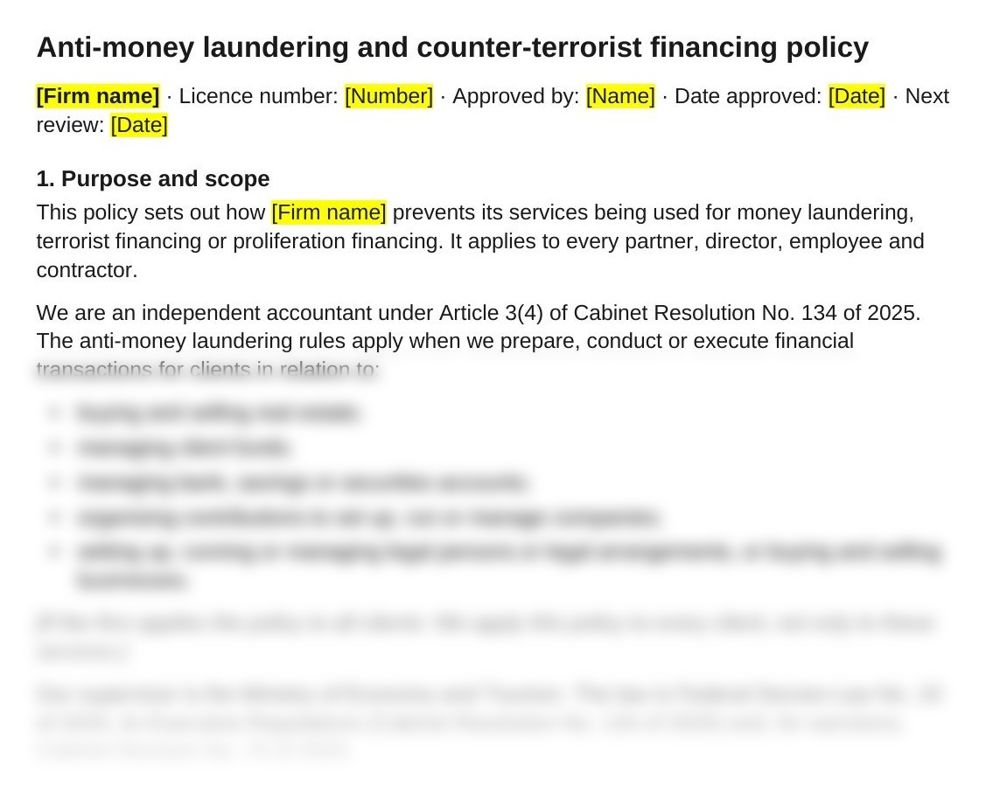
Set out how your firm stops its services being used for money laundering, terrorist financing and proliferation financing, under the UAE rules that took effect in 2025. This AML/CFT policy template is one Word document in 13 sections, from scope and roles to sanctions, reporting, records and sign-off.
Middle East and AfricaGet this pack and 109 more for $99
What the policy looks like
When you need it
In the UAE, independent accountants are designated non-financial businesses and professions under Federal Decree-Law No. 10 of 2025, which replaced Decree-Law No. 20 of 2018, and its Executive Regulations in Cabinet Resolution No. 134 of 2025. Firms on the mainland and in commercial free zones are supervised by the Ministry of Economy and Tourism, and their AML/CFT policies must be approved by senior management. Use the policy when:
- Your firm provides accounting or audit services on the UAE mainland or in a commercial free zone
- You are replacing a policy written under Decree-Law No. 20 of 2018
- You are appointing a compliance officer and need their duties in writing
- You have finished the enterprise-wide risk assessment and senior management needs a policy to approve
- The Ministry asks to see your policies before or during an inspection
How to use the AML/CFT policy template
- Fill in the firm's details. Firm name, approver, approval date and next review date at the top, and the names in Roles.
- Set the scope. Keep the optional line if you apply the policy to every client, not only the services listed in section 1.
- Set your review periods. Choose how often the compliance officer reports to senior management, and how often you review the risk assessment, train staff and run the independent review.
- Match it to your risk assessments. Check the high-risk client types in section 5 against your enterprise-wide and client risk assessments.
- Approve and share it. Senior management and the compliance officer sign section 13. Give every member of staff a copy and cover it in their training.
Questions
Which law covers AML for accountants in the UAE?
Federal Decree-Law No. 10 of 2025, which replaced Decree-Law No. 20 of 2018. Its Executive Regulations are in Cabinet Resolution No. 134 of 2025, which replaced Cabinet Resolution No. 10 of 2019 and took effect on 14 December 2025. Independent accountants fall under the designated non-financial businesses and professions.
Who supervises accountants for AML in the UAE?
The Ministry of Economy and Tourism. Its 2026 guidance rates independent accountants and auditors as medium inherent risk and medium-low residual risk, and expects firms to build that into their own risk assessment.
Does the compliance officer need approval?
Yes. The appointment needs the prior written approval of the supervisor. The compliance officer works at management level, with the authority, independence and resources the role needs. The policy also names a deputy.
What is the beneficial ownership threshold in the UAE?
25%. You identify each natural person who owns or controls 25% or more of a company. The Ministry's guidelines say firms should consider going below 25% where the risk calls for it.
How long must AML records be kept in the UAE?
At least five years from the latest of the end of the business relationship, the completion of an occasional transaction, the completion of an inspection or a final court judgment.
Do accountants need to register on goAML?
Yes. Designated non-financial businesses and professions must register on goAML, the Financial Intelligence Unit's system for suspicious transaction reports and other reports.
Also in the UAE AML compliance pack for accountants
Who it's for
Accounting and audit firms on the UAE mainland and in commercial free zones supervised by the Ministry of Economy and Tourism.
Last checked
Checked against Federal Decree-Law No. 10 of 2025, Cabinet Resolution No. 134 of 2025 and the Ministry of Economy and Tourism's guidelines for accountants and auditors in November 2026.