Form 8867 due diligence checklist and client interview questions
Interview every client who claims the earned income credit, child tax credit, American opportunity credit or head of household status, and record the answers at the time, as the due diligence rules require. This 8867 due diligence checklist is one Word document with a question set for each benefit and a preparer's sign-off.
US firmsGet this pack and 45 more for $69
You save $546 on buying them one by one
Buy the US library · $69Want every pack, for every region? Global library, 101 packs, $129
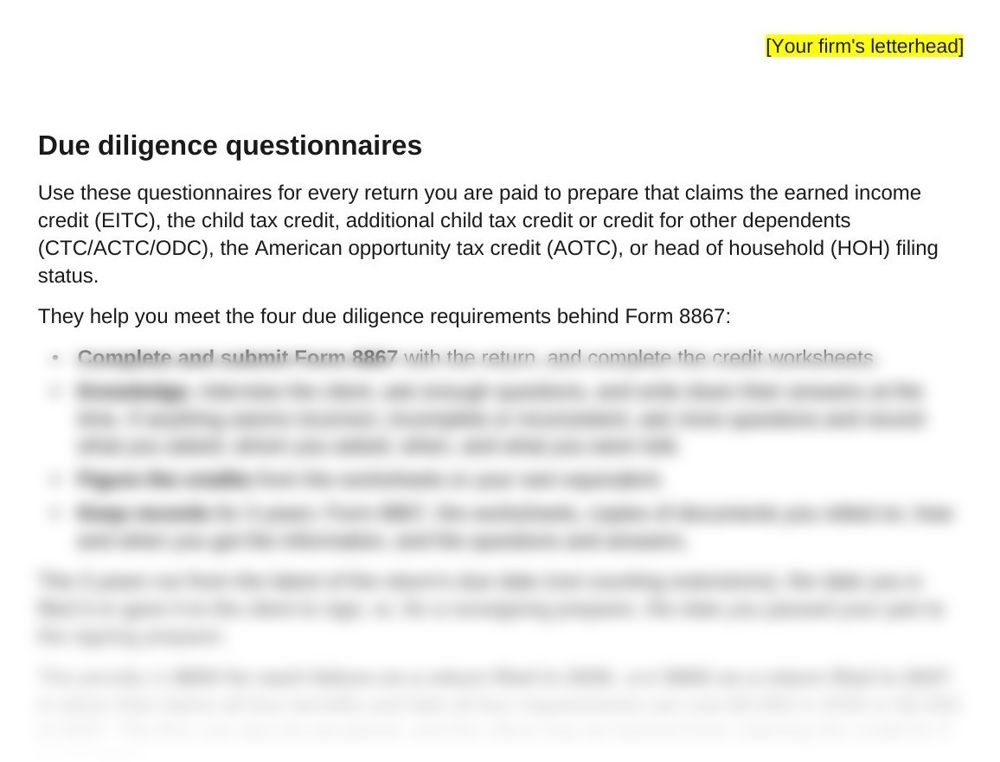
What the checklist looks like
When you need it
Form 8867 is the IRS's Paid Preparer's Due Diligence Checklist. A paid preparer who decides whether a client can claim these benefits must complete it, file it with the return and keep a record of the questions asked and the answers given. Use this checklist when:
- A return you are paid to prepare claims the earned income credit
- A return claims the child tax credit, additional child tax credit or credit for other dependents
- A return claims the American opportunity tax credit
- A client files as head of household, even with no credits claimed
How to use the 8867 due diligence checklist
- Fill in the return details. Client, tax year, who ran the interview, and the date and method.
- Ask the questions for every return. Then use only the parts for the benefits the return claims.
- Write the answers down at the time. Note each answer and the documents you saw, such as school, medical or landlord records for where a child lived.
- Follow up anything that doesn't add up. If an answer seems incorrect, incomplete or inconsistent, ask more and record what you asked, whom you asked, when, and the reply.
- Sign off and file. Tick the sign-off boxes, file Form 8867 with the return and enter the return in the due diligence log.
Questions
What is Form 8867?
The Paid Preparer's Due Diligence Checklist. A paid preparer completes it for any return that claims the earned income credit, the child tax credit, additional child tax credit or credit for other dependents, the American opportunity tax credit or head of household status. A preparer who e-files the return files Form 8867 electronically with it.
What are the due diligence requirements for tax preparers?
Four: complete and submit Form 8867, compute the credits on the IRS worksheets or your own equivalent, meet the knowledge requirement by interviewing the client and recording the questions and answers, and keep the records.
What is the penalty for not meeting due diligence?
$650 for each failure on a return filed in 2026, and $665 on a return filed in 2027. A return that claims all four benefits can carry four penalties, $2,600 in 2026. The IRS can also penalise the firm that employs the preparer.
How long do you keep due diligence records?
Three years from the latest of the return's due date (not counting extensions), the date you e-filed it or gave it to the client to sign, or, for a nonsigning preparer, the date you passed your part to the signing preparer. Keep Form 8867, the worksheets, copies of documents you relied on, and how, when and from whom you got the information.
What are due diligence notes?
The record of the questions you asked the client and their answers, made at the interview, plus any follow-up questions where information seemed incorrect, incomplete or inconsistent. The answer and documents columns on each question are where these notes go.
What happens to the client if a claim is wrong?
If the IRS examines the return and finds it incorrect, it can charge the client accuracy or fraud penalties. It can also ban the client from claiming the earned income credit, child tax credit or American opportunity credit for 2 or 10 years where the facts show reckless or intentional disregard of the rules, or fraud.
Also in the tax season engagement and consent kit
Who it's for
CPA firms, enrolled agents and tax preparers who prepare returns claiming the EITC, CTC, AOTC or head of household status.
Last checked
Checked against the Instructions for Form 8867, IRS Publication 4687 and the penalty amounts for returns filed in 2027, in November 2026.