Supplier payment policy template for UK companies
Write down how your company pays suppliers: your terms, what makes an invoice valid, how disputes are handled and what happens when you pay late. This supplier payment policy is one Word policy that matches the questions in the payment practices report.
UK companiesGet this pack and 109 more for $99
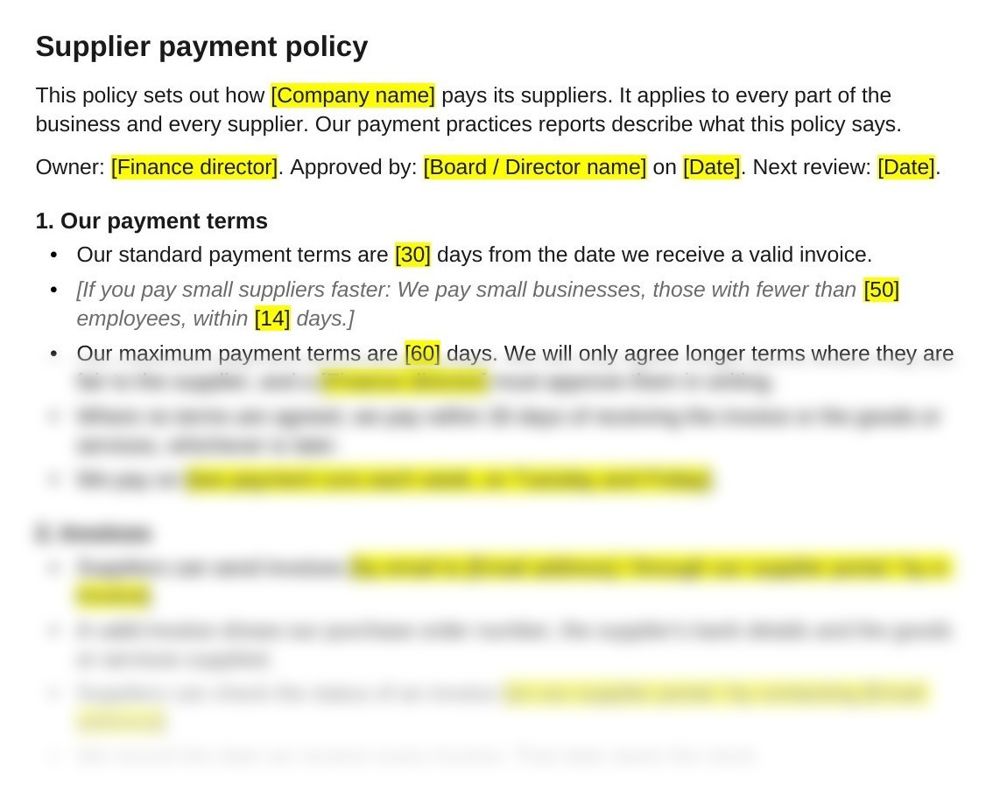
What the policy looks like
When you need it
Every company that buys on credit needs written terms. Large companies and LLPs that publish a payment practices report also describe their terms, disputes process, supply chain finance and payment codes in it, so the policy and the report need to say the same thing.
- Your company must publish a payment practices report every six months
- You bid for public sector work and are asked how fast you pay
- Suppliers complain about slow payment or unclear dispute handling
- You are changing your standard terms or adding supply chain finance
- A new finance director wants one written rule for every part of the business
How to use the supplier payment policy
- Set your terms. Fill in standard and maximum days, and keep the small supplier line only if you pay them faster.
- Name the invoice route. Email address, supplier portal or e-invoicing, and how suppliers check where an invoice is.
- Set the dispute timings. Days to raise a dispute, days to resolve it and who suppliers escalate to.
- Choose the two-version lines. Supply chain finance and payment codes each have a yes and a no version. Delete the one that doesn't apply.
- Approve it and publish it. Record the owner, the approver and the next review date, and share it with suppliers.
Questions
What should a supplier payment policy include?
Standard and maximum payment terms, what a valid invoice must show, how disputes are raised and resolved, how terms can change, what happens if you pay late, and whether you offer supply chain finance or belong to a payment code.
What are the maximum payment terms in the UK?
For business transactions an agreed payment date must usually be within 60 days. Longer terms are allowed only if they are fair to both sides. Public authorities must usually pay within 30 days.
When is a payment late if no terms were agreed?
30 days after the customer receives the invoice, or after the goods are delivered or the service provided, whichever is later.
What can a supplier claim if you pay late?
Statutory interest of 8% plus the Bank of England base rate, unless the contract sets a different rate, plus fixed compensation of £40 for a debt under £1,000, £70 up to £10,000 and £100 for £10,000 or more.
Which companies must publish a payment practices report?
Companies and LLPs that exceed two of the three medium-sized limits: £54 million turnover, £27 million balance sheet total and 250 employees. They report every six months, within 30 days of the end of each period, and a named director approves it.
Also in the supplier payment practices pack
Who it's for
Finance teams in UK companies who want written supplier terms that match what they publish and what they do.
Last checked
Checked against the late payment law and the payment practices reporting guidance in November 2026.