Reasonable cause letter for IRS penalty relief
Ask the IRS to remove a failure to file, failure to pay or failure to deposit penalty when something outside your client's control made them late. This reasonable cause letter is one Word letter with four ready paragraphs, sent under Form 2848.
US firmsGet this pack and 45 more for $69
You save $546 on buying them one by one
Buy the US library · $69Want every pack, for every region? Global library, 101 packs, $129
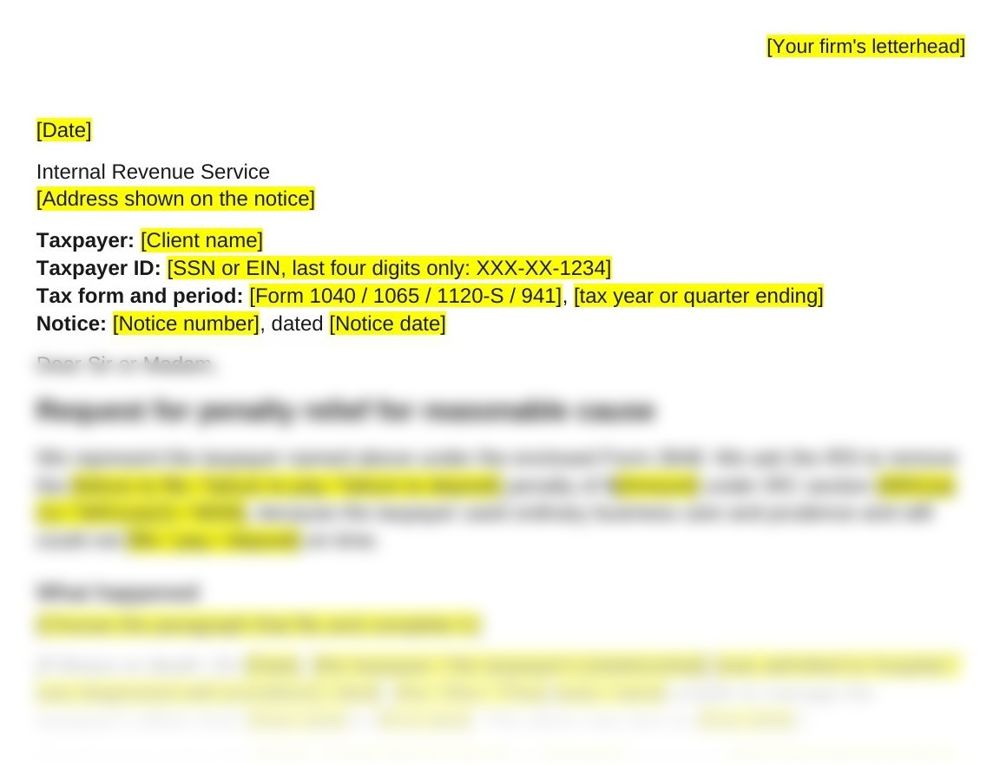
What the letter looks like
When to send it
The IRS gives relief for reasonable cause when a taxpayer used ordinary business care and prudence and still could not file, pay or deposit on time. Each request is judged on its own facts and circumstances. Send the letter when:
- The client or a close family member was seriously ill, or died, around the due date
- A fire, natural disaster or civil disturbance destroyed records or closed the business
- The client could not get records needed for the return, despite asking for them
- A system problem stopped an electronic filing or payment going through
- The client does not qualify for first-time abatement
How to use the reasonable cause letter
- Call first. The IRS can remove some penalties on a call to the number on the notice. If relief can't be approved by phone, send the request in writing.
- Fill in the heading. The client, the last four digits of the taxpayer ID, the form and period, and the notice number and date.
- Keep one paragraph under What happened. Choose illness, disaster, missing records or system problem, delete the others, and give the dates it started and ended.
- Show the client put it right quickly. Give the date the return was filed or the tax paid, and how many days that was after the circumstances ended.
- Enclose the evidence. Form 2848, a copy of the notice, and records such as a doctor's letter with start and end dates or copies of letters asking for records. Log the date sent in the pack's notice tracker.
Questions
What is reasonable cause for IRS penalty abatement?
The taxpayer used ordinary business care and prudence but could not file, pay or deposit on time because of circumstances beyond their control. The IRS lists fires and natural disasters, inability to get records, death or serious illness of the taxpayer or immediate family, and system issues that delayed an electronic filing or payment.
How do I write a reasonable cause letter to the IRS?
Say what happened and when, how it stopped the client filing or paying on time, and what they did to file or pay. Name the penalty and the tax period, ask for the penalty and its interest to be removed, and enclose supporting documents.
What does not count as reasonable cause?
The IRS says reliance on a tax professional, lack of knowledge, mistakes and oversights, and lack of funds on its own do not generally qualify. Reasonable cause also does not apply to the estimated tax penalty.
Should I ask for first-time abatement or reasonable cause?
Check first-time abatement first. If you ask for reasonable cause on a call and the IRS finds the client qualifies for first-time abatement, it applies first-time abatement instead. Use this letter when the client does not qualify.
Is the interest removed too?
Yes. When the IRS reduces or removes a penalty, it reduces or removes the related interest automatically.
What if the client stayed late after the problem ended?
Reasonable cause does not hold if the client failed to comply within a reasonable time once the circumstances ended. That is why the letter states how many days after the problem ended the client filed or paid.
Also in the IRS notice and penalty relief pack
Who it's for
CPA firms, enrolled agents and tax preparers who ask the IRS for penalty relief for individual and business clients.
Last checked
Checked against the IRS guidance on penalty relief due to reasonable cause and IRM 20.1.1.3 in November 2026.