Control testing template for finance and risk teams
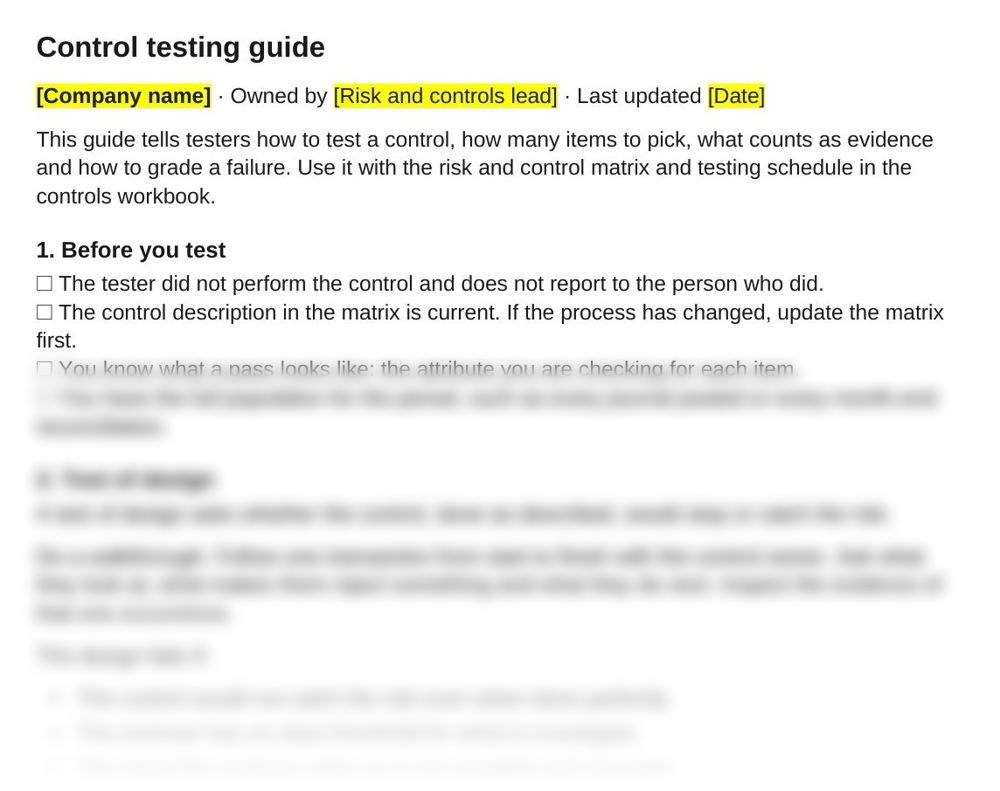
Test every control the same way: who can test it, how to walk through the design, how many items to pick, what counts as evidence and how to grade a failure. This control testing template is one Word guide that works with the testing schedule in the controls workbook.
UK and US companiesGet this pack and 51 more for $79
Want every pack, for every region? Global library, 110 packs, $99
What the guide looks like
When you need it
Under Provision 29 of the UK Corporate Governance Code 2024, for financial years beginning on or after 1 January 2026, the board declares in the annual report whether its material controls were effective at the balance sheet date. That declaration rests on testing done the same way across the year. Use the guide when:
- You plan the year's testing on the testing schedule
- A new tester joins the team or internal audit takes on controls work
- You run interim tests and the roll-forward to the balance sheet date
- A control has failed and you need to grade it and retest the fix
- The audit committee asks how controls were tested
How to use the control testing template
- Fill in the owner. Name your risk and controls lead and set the sample sizes, timing and retest periods in brackets.
- Check independence first. Work through the four Before you test boxes for each control.
- Test the design. Walk one transaction through with the control owner. If the design fails, log a deficiency and stop.
- Test operation. Pick a random sample across the whole period at the size the table shows, and inspect or reperform each item.
- Write up the test file. Record every point in the Evidence section and have a reviewer sign and date it.
- Grade any failure. Log it the same week and grade it before it goes to the audit committee.
Questions
What is control testing?
Checking that a control is designed to stop or catch the risk it covers, and that it worked every time across the period. The tester picks a sample, examines the evidence for each item and records a conclusion.
What is the difference between a test of design and a test of operating effectiveness?
A test of design asks whether the control, done as described, would stop or catch the risk. It is usually one walkthrough. A test of operating effectiveness asks whether the control worked every time across the period, and uses a sample.
What sample size should I use for control testing?
The guide's minimums depend on how often the control runs: one for an annual control, two for quarterly, two for monthly, five for weekly, 20 for daily and 25 for controls that run many times a day, with higher counts for material controls. If the population is smaller than the sample, test every item.
What counts as evidence of a control?
Evidence that shows who performed the control and when, such as a signed and dated review, an approval in the system, a log or a ticket. Asking the owner is never enough on its own, and an initialled report with no date does not show the review was on time.
What happens if a control test fails?
One exception counts as a failure unless you can show it was isolated by extending the sample. If the extra items are clean, the control operated with a documented exception. If not, the control failed and goes on the deficiency log.
What does Provision 29 ask the board to report?
A description of how the board monitored and reviewed the effectiveness of the risk management and internal control framework, a declaration of effectiveness of the material controls at the balance sheet date, and a description of any material controls that did not operate effectively, with the action taken or planned.
Also in the internal controls register
Who it's for
Finance and risk teams that test the controls behind a board's declaration on material controls.
Last checked
Checked against the FRC's UK Corporate Governance Code 2024 in November 2026.