Worker classification checklist: employee or independent contractor
Decide whether a worker is an employee or an independent contractor before the work starts, and keep a record of why. This worker classification checklist is one Word document with 15 questions on the IRS common-law factors, a decision box and a list of what to keep on file.
US firmsGet this pack and 51 more for $79
Want every pack, for every region? Global library, 110 packs, $99
What the checklist looks like
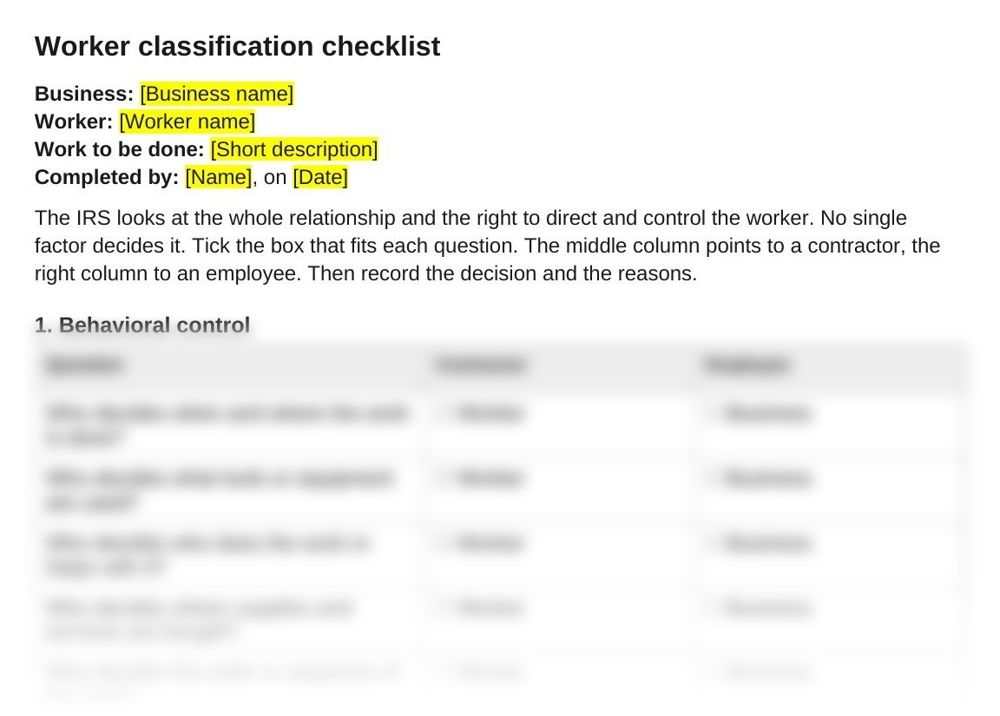
When you need it
The IRS expects a business to look at the whole relationship, weigh all the factors and document the ones it used to reach its decision. No single factor decides it. Complete the checklist when:
- You engage a freelancer, consultant or other contractor for the first time
- A contractor's role grows, with set hours, your equipment or no end date
- A former employee comes back to do similar work as a contractor
- A client asks you, as their accountant, whether a worker belongs on payroll
How to use the worker classification checklist
- Fill in the heading. Name the business, the worker and the work, and who is completing the checklist.
- Answer every question. Tick the contractor or the employee box, based on how the work will be done in practice, not only on what the contract says.
- Count the answers. Record how many point each way, then weigh them. No set number of answers makes a worker an employee.
- Record the decision and the reasons. Contractor, employee or unclear. For an unclear case, the business or the worker can file Form SS-8.
- Keep the evidence. File the signed checklist with the agreement and proof of the worker's own business, and complete a new one if the role changes.
Questions
How does the IRS decide if a worker is an employee or a contractor?
It looks at evidence of control and independence in three groups: behavioral control, financial control and the type of relationship. The key question is how far the business has the right to direct and control the worker. No single factor decides it.
What are the three categories of the common-law test?
Behavioral: does the business control what the worker does and how? Financial: does it control the business side, such as how the worker is paid, expenses and tools? Type of relationship: is there a written contract or employee-type benefits, will it continue, and is the work a key part of the business?
What happens if you misclassify an employee as a contractor?
If you have no reasonable basis for treating the worker as a contractor, you can be held liable for the employment taxes for that worker under section 3509.
What is Section 530 relief?
Relief from employment taxes for a business that had a reasonable basis for not treating a worker as an employee, filed all required information returns on that basis, and has not treated any worker in a substantially similar position as an employee. It does not make the worker a contractor.
What is Form SS-8?
The form a business or a worker files to ask the IRS to decide the worker's status for federal employment taxes and income tax withholding. A determination can take at least six months.
Is a remote worker a contractor?
Not because they work remotely. A remote worker is an employee under the common-law rules if you can control what will be done and how, even if the worker chose to work remotely.
Also in the independent contractor pack
Who it's for
CPA firms, bookkeepers and small business owners in the US who engage freelancers, consultants and other contractors.
Last checked
Checked against IRS guidance on independent contractors and employees and on Form SS-8 in November 2026.