Estate assets and liabilities spreadsheet for executors
List everything the person who died owned and owed, see which IHT400 schedule each asset goes on, and track letters, replies and money collected until the estate is gathered in. This estate assets and liabilities spreadsheet is one Excel workbook for estates in England and Wales, with an inheritance tax estimate and the payment and IHT400 dates.
UK practicesGet this pack and 109 more for $99
What the spreadsheet looks like
When executors need it
Before an executor can pay inheritance tax, send the IHT400 or apply for probate, they need a full list of what the estate holds and owes at the date of death. Inheritance tax is due by the end of the sixth month after the death, so someone who died in January has until 31 July. Where tax is owed, the IHT400 goes to HMRC within one year. Use the spreadsheet when:
- You act for the executors of an estate and need one list of every asset and debt
- You are writing to banks, pension providers and share registrars and need to track who has replied
- You have to fill in the IHT400 and want each asset sorted by schedule
- The executors want an early idea of the inheritance tax bill and the payment date
- Money is coming in from several places and you need to match it to the estate accounts
How to use the estate assets and liabilities spreadsheet
- Delete the examples. Rows marked [Example] on the Assets and Liabilities sheets show how it works. Clear them before you enter the real estate.
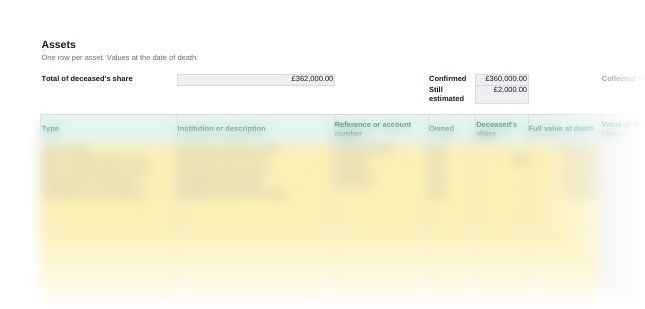
- List the assets. One row per asset. Pick the type, say whether it was owned alone or jointly, and enter the value at the date of death. For a joint asset, enter the full value and the deceased's share.
- Record the letters. Enter the date you wrote and the date the reply came back, then mark the value estimated or confirmed. When money arrives, enter the amount and the date.
- List the debts. One row per debt, including the funeral. Enter the date paid when each one is settled.
- Fill in the Summary. Enter the date of death, gifts in the seven years before death, what passes to a spouse, civil partner or charity, any transferred bands and the home details. The Check cell shows OK when the inputs make sense.
Questions
What values go in an estate assets and liabilities spreadsheet?
The value of each asset and debt at the date of death, not what it later sells for. The spreadsheet keeps the value at death and the amount collected in separate columns, so a house valued at £300,000 that sells for more still shows its value at death.
Which IHT400 schedule do joint assets go on?
Jointly owned assets go on schedule IHT404, whatever kind of asset they are. The spreadsheet shows IHT404 for any row marked Joint and the usual schedule for everything else.
How does the spreadsheet estimate inheritance tax?
It takes the net estate, removes what passes to a spouse, civil partner or charity, and deducts the £325,000 nil rate band less gifts in the last seven years. If the home goes to children or grandchildren it adds the residence nil rate band of up to £175,000, cut by £1 for every £2 the estate is over £2 million. Tax is 40% of what is left.
Can a late spouse's unused nil rate band be added?
Yes. Enter the unused share of a late spouse's or civil partner's nil rate band and residence nil rate band as a percentage, and the spreadsheet adds it to the estate's own bands.
What does the inheritance tax estimate leave out?
The 36% rate for estates that leave 10% or more to charity, business and agricultural relief, gifts with reservation, trusts and taper relief on gifts. Unused pension funds come into the estate for deaths from 6 April 2027 and are also left out. Use the IHT400 for the final figure.
When is inheritance tax due?
By the end of the sixth month after the death. The Summary sheet works out that date and the IHT400 deadline, one year after the death, from the date you enter.
Also in the estate administration pack
Who it's for
Accountancy practices that act for executors, and executors handling an estate in England and Wales.
Last checked
Checked against HMRC's inheritance tax thresholds, its IHT400 schedules and GOV.UK guidance on the residence nil rate band and paying inheritance tax in November 2026.