E-invoicing readiness checklist for EU businesses
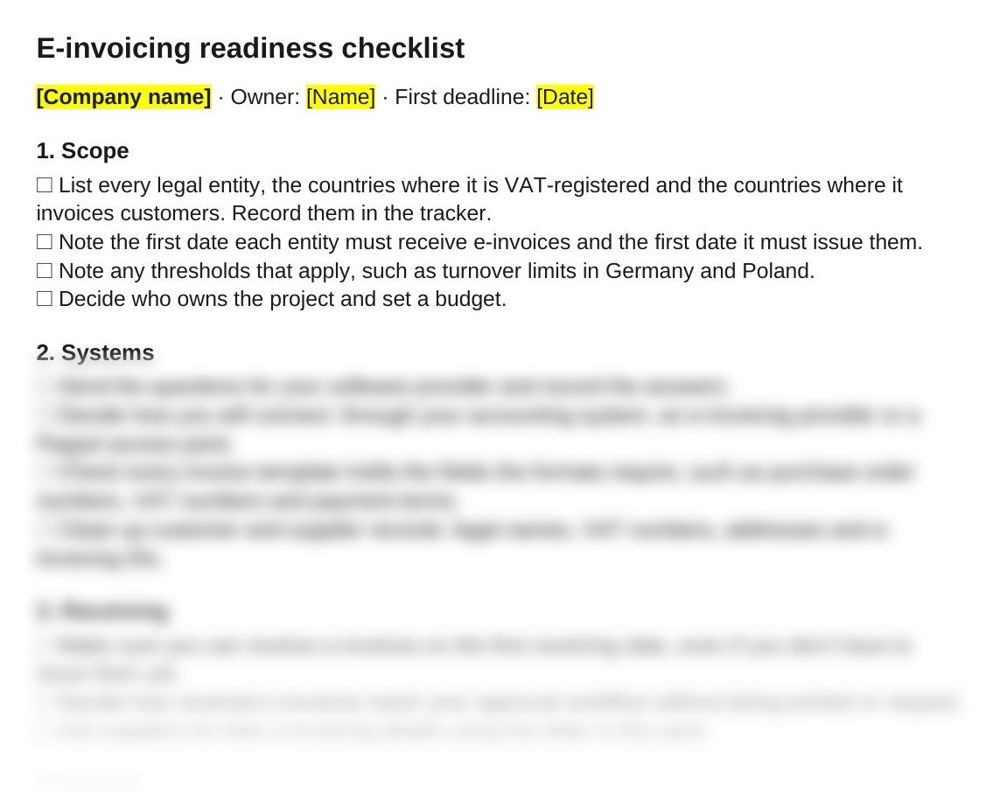
Work through every step between learning that e-invoicing applies to you and sending your first structured e-invoice, with a tick box for each. This e-invoicing readiness checklist is one Word document in seven stages, with an owner and your first deadline at the top.
EU businesses- In the pack
- E-invoicing readiness pack
- Files
- 5, Word and Excel
Get the pack by email
What the checklist looks like
Who needs one
Across the EU, PDF and paper invoices between businesses are being replaced by structured e-invoices. As at November 2026, Belgian VAT-registered businesses have had to use them since 1 January 2026. In France, every business must be able to receive them from 1 September 2026, large and mid-sized companies must issue them from the same date, and smaller ones from 1 September 2027. German businesses have had to be able to receive them since 1 January 2025. From 1 July 2030, EU rules make e-invoices the norm for cross-border sales between EU businesses. Use this one when:
- A country where you invoice has set a date for receiving or issuing e-invoices
- You run several entities across EU countries with different dates
- Your accounting or ERP system has not yet been checked for e-invoicing
- You advise clients who invoice in EU countries and need one plan to work from
How to use the e-invoicing readiness checklist
- Fill in the top line. Company name, the person who owns the project and your first deadline.
- Scope first. List every entity and its dates in the pack's tracker, which works out when each one is affected.
- Send the questions and the letter. Use the pack's software provider questions and the letter to customers and suppliers, then tick those steps off.
- Get receiving ready before issuing. In France and Germany, businesses must be able to receive e-invoices before they have to send them.
- Set the review period. Choose how long to run in parallel and when to review, then use what you learn for the next country.
Questions
When is e-invoicing mandatory in the EU?
Each country sets its own date for domestic invoices. Belgium started on 1 January 2026, France on 1 September 2026, and Germany has required businesses to receive e-invoices since 1 January 2025. For cross-border sales between EU businesses, e-invoices become the norm from 1 July 2030.
When does e-invoicing start in France?
From 1 September 2026, every business must be able to receive e-invoices, and large and mid-sized companies must issue them. Small and medium-sized companies and micro-businesses must issue them from 1 September 2027.
When does e-invoicing start in Germany?
German businesses have had to be able to receive e-invoices since 1 January 2025. Businesses can still issue other invoices until the end of 2026, or until the end of 2027 if their turnover in the previous year was €800,000 or less.
Is e-invoicing mandatory for small businesses?
Yes, though often later than for larger businesses. In France, small businesses must issue e-invoices from 1 September 2027 and be able to receive them from 1 September 2026. In Germany, businesses with turnover of €800,000 or less can issue other invoices until the end of 2027. In Belgium, every VAT-registered business has been in scope since 1 January 2026.
Is a PDF invoice an e-invoice?
No. An e-invoice is a structured file that software can read without anyone retyping it. In Germany, an invoice counts as an e-invoice only if it is in a structured format, so a plain PDF sent by email doesn't. In Belgium, e-invoices are sent through the Peppol network.
Also in the e-invoicing readiness pack
Who it's for
Finance teams and accounting practices with businesses that invoice in EU countries.
Last checked
Dates checked against EU law and the Belgian, French and German tax authorities in November 2026.