Capitalization policy template for fixed assets, with the de minimis election
Decide which purchases the business expenses when paid and which it records as fixed assets, and have that in place before the tax year starts so the de minimis safe harbor applies. This capitalization policy template is one Word policy with the $2,500 or $5,000 limit, cost rules with worked examples, useful lives, the fixed asset register, a year-end checklist and the yearly election statement.
US firmsGet this pack and 51 more for $79
Want every pack, for every region? Global library, 110 packs, $99
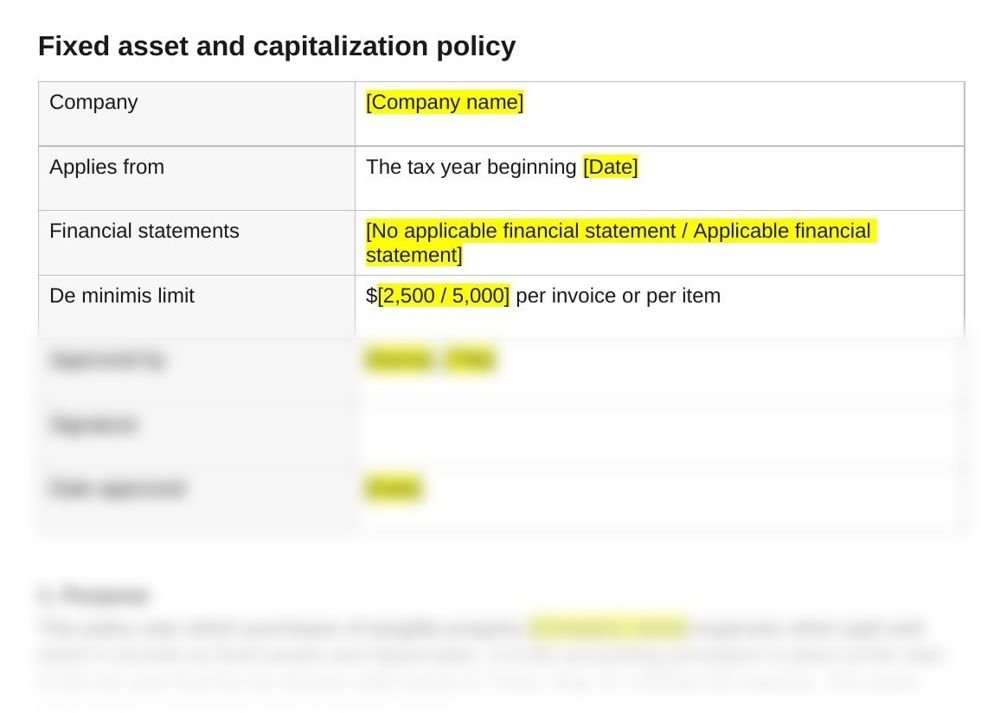
What the policy looks like
When you need it
To use the de minimis safe harbor, a business needs accounting procedures in place at the beginning of the tax year that expense items costing less than a set amount, and it must follow them in its books. With an applicable financial statement the procedures must be in writing. Without one they don't have to be, but a written, approved policy is the record of them. Adopt it when:
- A new business sets up its books
- Before the first day of each tax year, to approve the limit for that year
- A business starts producing audited statements for a lender and moves to the $5,000 limit
- Year end comes and the election statement needs to go with the return
- Someone asks whether to split a purchase across invoices to get under the limit
How to use the capitalization policy template
- Choose the limit. $2,500 per invoice or item without an applicable financial statement, $5,000 with one. A compiled or reviewed statement means $2,500.
- Approve it before the year starts. Fill in the company, the tax year it applies from, the approver and the date.
- Set the useful lives. Keep or change the lives for each class, and keep the leasehold line if the business rents its premises.
- Code purchases by the policy. Expense items at or under the limit, including invoice costs. Add everything over it to the fixed asset register.
- Run the year-end checklist. Agree the register to the balance sheet and attach the election statement to the timely filed original return, including extensions.
Questions
What is a capitalization policy?
A written rule that sets which purchases a business expenses when paid and which it records as fixed assets and depreciates. In the US it usually carries the de minimis limit, so the books and the tax return treat small purchases the same way.
What is the capitalization threshold for fixed assets?
For the de minimis safe harbor, up to $2,500 per invoice or item without an applicable financial statement, and up to $5,000 with one. The IRS says these limits decide whether an amount qualifies under the safe harbor. They are not a ceiling on what a business can deduct.
Do I need a written policy for the de minimis safe harbor?
With an applicable financial statement, yes: the procedures must be in writing at the beginning of the tax year. Without one, written procedures are not required, but you must expense amounts in your books under a consistent procedure that existed at the start of the year.
How do you make the de minimis safe harbor election?
Attach a statement titled "Section 1.263(a)-1(f) de minimis safe harbor election" to the timely filed original federal return, including extensions, with your name, address, taxpayer identification number and a statement that you are making the election. It applies to every qualifying amount that year and cannot be revoked.
Must every item over the limit go on the balance sheet?
No. An amount over the limit just doesn't qualify under the safe harbor. You then apply the normal rules, so repairs and maintenance and incidental materials and supplies can still be deducted.
Is a reviewed financial statement an applicable financial statement?
No. An applicable financial statement is one filed with the SEC, a certified audited statement with an independent CPA's report used for credit, reporting to owners or another substantial non-tax purpose, or one a federal or state agency other than the SEC or the IRS requires. A compiled or reviewed statement means the $2,500 limit.
Also in the US small business setup pack
Who it's for
US small businesses, their bookkeepers and the CPA firms that set up their books, including sole proprietors, S corporations and partnerships.
Last checked
Checked against Treas. Reg. 1.263(a)-1(f) and IRS guidance on the tangible property regulations in November 2026.