
SAP Payments for Finance Teams Now Run Inside SAP Cloud ERP
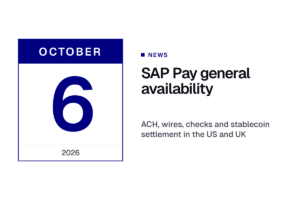
SAP Pay, powered by Tereina, executes ACH, wire, check and stablecoin payments inside SAP Cloud ERP in the US and UK from October 6.
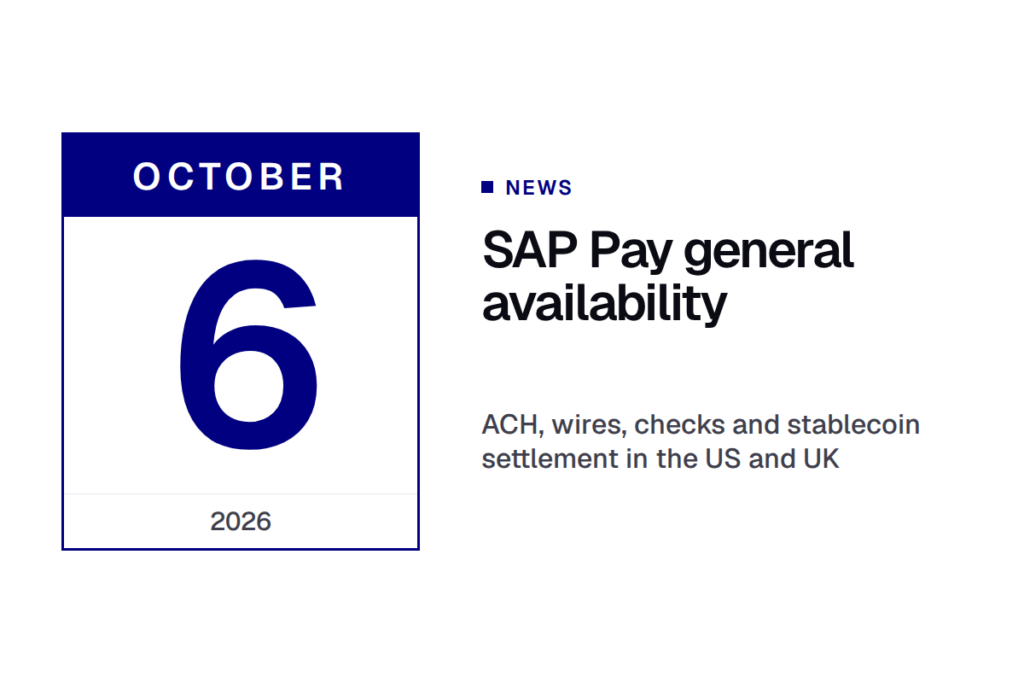
SAP launched SAP Pay on October 6, 2026, a payment service built into SAP Cloud ERP that executes ACH transfers, wires, checks and stablecoin settlement, generally available in the United States and the United Kingdom. SAP payments for finance teams now run from the ledger rather than from a bank portal.
The service is powered by Tereina, an SAP company set up in April 2026 as a regulated payment service provider. It pays an invoice when it falls due and reconciles the transaction in the same workflow, SAP said.
For a finance team, the change is where payment execution sits. Today most SAP customers approve an invoice in the ERP, export a payment file and hand it to a bank or a third-party processor. SAP Pay removes that handoff for customers who adopt it.
That puts SAP in more direct competition with the payment tools of rivals and specialists. It also raises questions about bank connectivity, stablecoin risk and pricing that SAP has not answered in public.
What SAP payments for finance teams include
SAP said the service supports electronic funds transfers, including automated clearing house payments, wires and checks. Stablecoin-based settlement is offered for cross-border transactions.
The service requires the SAP Multi-Bank Connectivity add-on, according to ERP Today’s coverage of the announcement at SAP Connect 2026. SAP did not name the banks behind the service in the material available at publication.
A global distributor of networking and wireless broadband products already uses SAP Pay for supplier and treasury payments, SAP said. The company was not named.
David Imbert, head of finance product marketing at SAP, framed the product as a matter of logic. “This will basically give our customers access to a wide variety of payment methods,” he said. “Why wouldn’t you just directly execute and pay them?”
An SAP spokesperson said the difference lies in where the controls sit. “What differentiates SAP Pay is that by embedding payment execution directly into SAP Cloud ERP, we’re bringing payment execution, reconciliation, controls and auditability into the same workflow,” the spokesperson said.
SAP’s own SAP Pay product page describes the service as a link between the ERP and blockchain-based payment networks for payments around the clock.
How the service handles reconciliation and controls
The reconciliation claim is the one finance teams should test first. When an invoice is approved, SAP Pay executes the payment and matches it to the invoice or purchase order without a separate bank file. That shortens the manual bank reconciliation step that follows a payment run.
SAP has not published detail on approval limits, segregation of duties or how failed and returned payments are treated. Those are the points an auditor will ask about. Teams moving payment execution into the ERP should map them against an existing internal controls register before go-live.
SAP is also moving towards agents that act on payments. It unveiled AI assistants for pricing adjustments and financial disclosure alongside SAP Pay. Early adopter programmes for further agents covering financial close, planning, treasury, billing, tax and receivables are planned for the first quarter of 2027.
An agent that can trigger a payment needs clear limits on what it may approve. Our guide to AI agent governance for finance teams sets out where to begin.
Stablecoin settlement: what is live and what is not
SAP lists stablecoin settlement among the supported methods at general availability, limited to cross-border payments. A crypto trade outlet reported that the service connects to Circle for USDC. SAP did not name its stablecoin partners in the material reviewed here, and the chains and tokens supported could not be confirmed against an SAP document.
Reports on regions differ. Coverage of the announcement gives the United States and the United Kingdom, which matches SAP’s statement. One outlet cited the United States and the European Union. Finance teams in the EU should confirm eligibility with SAP before planning around it.
Pricing is the other gap. The announcement carries no price list. One trade report described pricing as quote-based and tied to transaction volume, but SAP has not confirmed that.
The rules that touch stablecoin payments
Stablecoin rails bring regulation that ACH and wires do not. In the United States, the GENIUS Act was signed on July 18, 2025. It takes effect on the earlier of January 18, 2027 or 120 days after final implementing rules are issued.
The Act requires issuers of payment stablecoins to hold reserves of at least one dollar for every dollar issued. They must also publish redemption procedures and periodic reports on reserve composition. A treasury team holding or settling in a stablecoin depends on the issuer meeting those terms.
In the EU, the Markets in Crypto-Assets Regulation treats fiat-pegged stablecoins as e-money tokens, whose issuers must be a credit institution or an electronic money institution. ESMA confirmed in April 2026 that the transitional period ended on July 1, 2026 in all 27 member states.
UK finance teams sit outside both regimes, so they should check what their bank and Tereina treat as an acceptable token. Neither SAP nor Tereina has said how the service maps to those rules.
How SAP Pay compares with Oracle, Workday, BILL and Coupa
CFO Dive placed the launch alongside payment features that Oracle and Microsoft Dynamics already offer inside their ERPs. The U.S. Faster Payments Council described the trend in a July 13, 2026 paper as a shift towards “payment command centers” that give CFOs cash visibility and help with working capital.
No customer or analyst comparison with Workday, BILL or Coupa was available at publication. Those vendors sell payments as part of accounts payable and spend platforms rather than from within a general ledger. Buyers weighing the two models can start with our BILL vs Coupa comparison.
The trade-off is plain. SAP can tie payment to the purchase order and invoice already in the ERP. Specialist tools usually work across more than one ledger and often have broader bank and payee networks.
What SAP payments for finance teams mean next
SAP Pay is open to SAP Cloud ERP customers in the US and UK now. The next marker is the first quarter of 2027, when SAP plans early adopter programmes for its finance agents. The GENIUS Act comes into force by January 18, 2027 at the latest.
Accountio.
The go-to weekly newsletter for accounting professionals. Trusted by 10,000+ industry leaders to deliver the tech trends and insights that matter most. Join them today.